Models
- How does an organization change? In Burke's novel, "Organization Change: Theory and Practice" he explains these models listed below to help an organization achieve the, "how" or process of change. Please select one of these models for your organization.
The
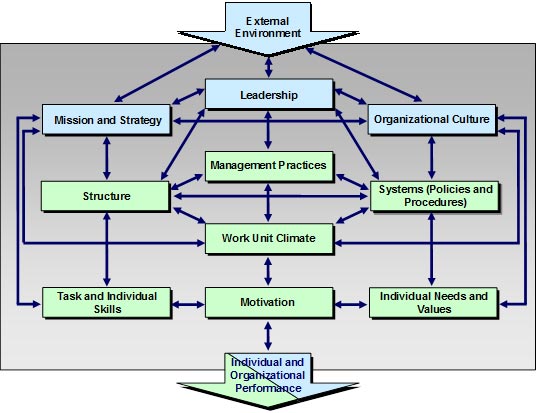
Burke-Litwin Model. These
twelve components represent our choices of what we consider to be primary for
organization change. It is clear to
determine that this model conforms to an open system where the external
environment is the input and performance is the output. The remaining ten boxes serve as throughputs
and the feedback loop connects the input with the output. This model is very effective because it
involves components at each level of the organization.
Weisbord’s
Six-Box Model. One
of the strengths of Weisbord’s model is the position of the leadership
box. Being right in the middle, the
leadership box connects with all of the other five components. One major weakness with this model is the
fact that there are only six components.
Many criticize his model saying that an organization is much more
complex and the six components are simply not sufficient.
Tichy’s
TPC Framework Model. Tichy’s
nine components are viewed as change levers and not “boxes.” His nine components are the external
environment, mission, strategy, managing organizational mission and strategy
processes, task, prescribed networks, organizational processes, people, and
emergent networks. Technical, political, and cultural represent the three
primary systems in the model. The
technical system is based on science, the political system is based on power
dynamics, and the cultural system is based on shared values.